A-Io
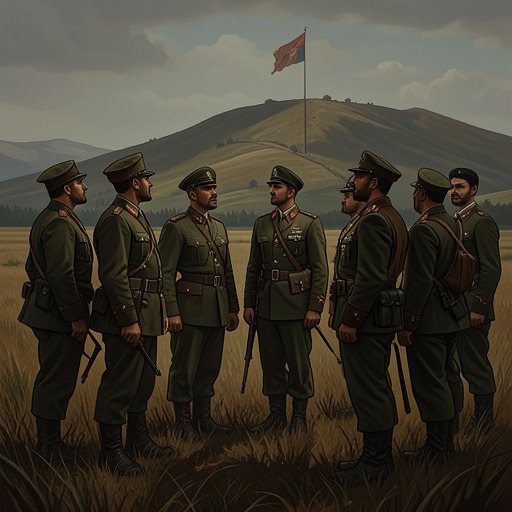
The DispossessedA-Io is the powerful nation on Urras where Shevek completes his work on General Temporal Theory, encounters a society unlike the one he left on Anarres, and comes to recognize how hospitality, scholarship, and political power can converge. Its universities, comfortable cities, and cultivated landscape complicate his inherited image of Urras as nothing but injustice and waste; its control over movement and research, intervention in Benbili, and violent response to protest reveal the coercive order beneath that prosperity. A-Io is therefore not merely Shevek’s destination but the testing ground for his conviction that knowledge must be shared rather than possessed.
Setting and Social Order
A-Io presents itself to Shevek through ceremony and abundance. On his arrival at Ieu Eun, he is carried into a reception beneath a golden ceiling hung with crystal lights, where national and university officials, diplomats, scientists, and politicians greet him as a celebrated visitor. The splendor of the occasion is real, but so is its hierarchy: the guests bear elaborate titles, the President of the Senate speaks for the nation, and Shevek is treated as a distinguished individual whose arrival may inaugurate a new era between the Twin Planets.
The university gives him another view of the same society. It has sixteen thousand students and faculty, with dormitories, refectories, theaters, and meeting rooms that remind him of an Odonian community. Yet it is exclusively male, extraordinarily luxurious, very old, and organized hierarchically rather than federatively. Its resemblance to a community is not enough to erase the difference in how authority is arranged. The institution offers Shevek the intellectual company and resources missing from Anarres, while placing him inside a social structure whose premises he does not share.
A-Io’s material prosperity also unsettles his expectations. In the countryside he sees farms, villages, towns, lakes, hills, and the old fortresses of a feudal past. His guides describe regulation and taxation as tools for conserving resources and controlling luxuries that could consume scarce materials or damage the environment. Shevek is struck by the apparent well-being of the people he encounters: they are well dressed, well fed, and busy at their work, not simply waiting to be ordered. Their evident competence makes his inherited condemnation of Urras inadequate, even as it leaves the question of inequality unresolved.
A Guest Under Management
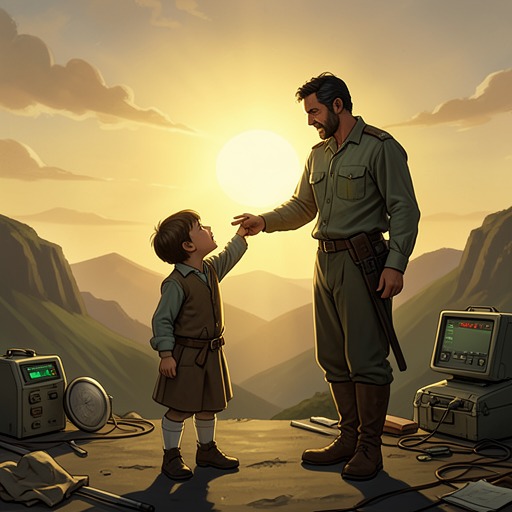
Shevek arrives without money or gifts, and makes the mismatch between his society and A-Io’s economy explicit. He explains to the ship’s doctor that because he cannot buy what he needs, he must depend on others to give it to him; he calls himself the Beggarman, but also insists that his presence makes the Urrasti give rather than sell. Later, when clothes and other necessities have been arranged for him, he again describes himself as arriving with empty hands. The repeated explanation turns an ordinary arrangement for a guest into a dispute about what sustenance means: a gift freely given, or a cost borne by a host and its government.
A-Io’s officials describe Shevek as the private guest of Ieu Eun University, not an ambassador, while acknowledging that his visit has government approval and the approval of the Council of World Governments. That distinction leaves him both privileged and politically exposed. He wants communication and the dismantling of the wall between the planets, but he has not come as a representative empowered to speak for Anarres. A-Io can honor him as an individual physicist while still deciding the conditions under which he encounters the country.
The country’s handling of information sharpens that tension. Shevek reads newspapers from Thu and Benbili and learns how sharply their forms of control differ: the Thuvian government paper is better written but reports only what the state permits, while A-Io’s press is described as free despite being dismissed by the educated as full of inferior material. The contrast gives Shevek a concrete view of competing systems of authority over public information. Later, when A-Io is officially at war with Thu, the university’s scientific research becomes subject to classification and publication may be delayed by authorities who consider work dangerous. Travel is also restricted: non-nationals, including Shevek, are not supposed to leave campus without the Chancellor’s clearance. Pae jokes that he can help Shevek get around the rules, but the joking does not remove the power those rules give the state.
War, Protest, and State Power
A-Io’s power extends beyond its own borders. Shevek follows reports of the Benbili revolution, including news that rebels have taken territory, that the retreating army is burning fields and towns, and that revolutionaries have opened the prisons. The popular papers announce the uprising in enormous type, a sharp contrast with the brief, dry official reports. Shevek is drawn to the news and wonders whether he should have gone to Benbili. When the Council of World Governments hears that A-Io is sending armed reinforcements in support of Benbili’s existing government, the intervention alters the meaning of the revolution for him: A-Io’s political ideals are not confined to the generous public image offered to its guest.
The war changes Shevek’s circumstances inside A-Io as well. After A-Io and Thu clash near the Benbili capital, Pae reports that the capital has been retaken and General Havevert will be restored, while noting that the fighting continues as Thu holds eastern provinces. He presents the conflict as a limited police action, not a war to be fought in the heartlands of the high civilizations, but confirms that the two nations are officially at war. That official state activates restrictions on research and travel even as his hosts continue to treat them as manageable inconveniences. A-Io can thus preserve the appearance of ordinary life at home while exercising exceptional control over a visiting scientist.
The tension erupts in Nio Esseia. Antiwar activists, syndicalists, libertarians, and other opponents of central authority organize against conscription, war taxes, and rising food prices. A demonstration and general strike take place against a background of mass unemployment; Shevek joins the public gathering and speaks before police helicopters drown out his voice. In Capitol Square, the aircraft fire on the crowd. People press toward the exits and the Directorate building for shelter, while the noise and panic make it difficult to tell whether the shooting has stopped. After the soldiers enter the building, they find the word “DOWN” written in blood on the foyer wall. The scene makes the gulf between A-Io’s polished institutions and its use of force unmistakable.
Knowledge, Property, and Political Meaning
Shevek understands his visit as a bargain, but not one in which he will simply sell his discovery. He tells Chifoilisk that he came to bargain with A-Io because he wants his people to come out of exile, restore free exchange between Anarres and Urras, and bring down the walls separating them. He believes A-Io has forgotten the revolution and assumes people can be satisfied by possessing enough. His own presence among scholars and wealthy people, kept away from the populace, seems to him part of a plan to obtain his scientific work while insulating him from the society it might affect.
The distinction between scientific achievement and political commitment finally becomes impossible for him to ignore. Shevek tells Keng that the conversation, the Light Laboratory experiment, and books from another world gave him the stimulus needed to finish his theory. But he also recognizes that he has been made by the Anarresti idea of freedom, change, and human solidarity, and that allowing A-Io’s propertarians to buy the truth would betray that inheritance. His question about whether there can be a gift rather than a sale leads to a concrete proposal: Keng should broadcast the equations to physicists on Urras, Hain, and other worlds, so the work cannot become an Ioti possession, investment, or weapon. A-Io has supplied the conditions in which the theory could be completed; Shevek refuses to let those conditions confer ownership of it.
His relationship to A-Io is therefore neither uncomplicated rejection nor acceptance. The country gives him the intellectual exchange he could not find at home, and its prosperous landscape forces him to reconsider what he thought he knew about Urras. Yet the Benbili intervention, restrictions imposed under wartime authority, and crackdown in Nio reveal how A-Io’s language of order and civilization can coexist with domination. When Shevek seeks refuge at the Terran embassy, its ambassador observes that A-Io’s government brought him among scholars and the rich to keep him from the populace, while he explains that he came for the idea and now wants to save it from being made property. A-Io’s decisive significance lies in that contradiction: it is at once the place where a wall-crossing exchange becomes possible and a state whose political and economic order would turn that exchange into an instrument of power.
Boundaries and the Possibility of Return
A-Io’s influence over Shevek ends at the question of whether he can leave. After the Nio uprising is suppressed, he tells Keng that he does not want to remain on Urras and asks for help returning home. He recognizes that the Ioti government may prefer to let him disappear, since an absent anarchist can be forgotten more easily than a dead one made into a martyr. His request shows how little the formal honor of his reception guarantees his freedom once the state regards him as politically suspect.
The boundary is reciprocal but not equal. In a discussion about the closure of the settlement, Rulag says that an Anarresti may leave if the propertarians’ freighters will carry him, but cannot return: under the settlement terms, arriving passengers may not leave freight ships beyond the boundary of the Port of Anarres. The stated rule is directed at the port on the other planet, yet it frames the conditions under which Shevek’s departure from A-Io could become a return to Anarres. Against A-Io’s restrictions on the movement of a non-national during wartime, the settlement boundary makes planetary separation an institutional fact, not merely an image. The possibility of sharing ideas across the divide depends on people being able to cross it too.